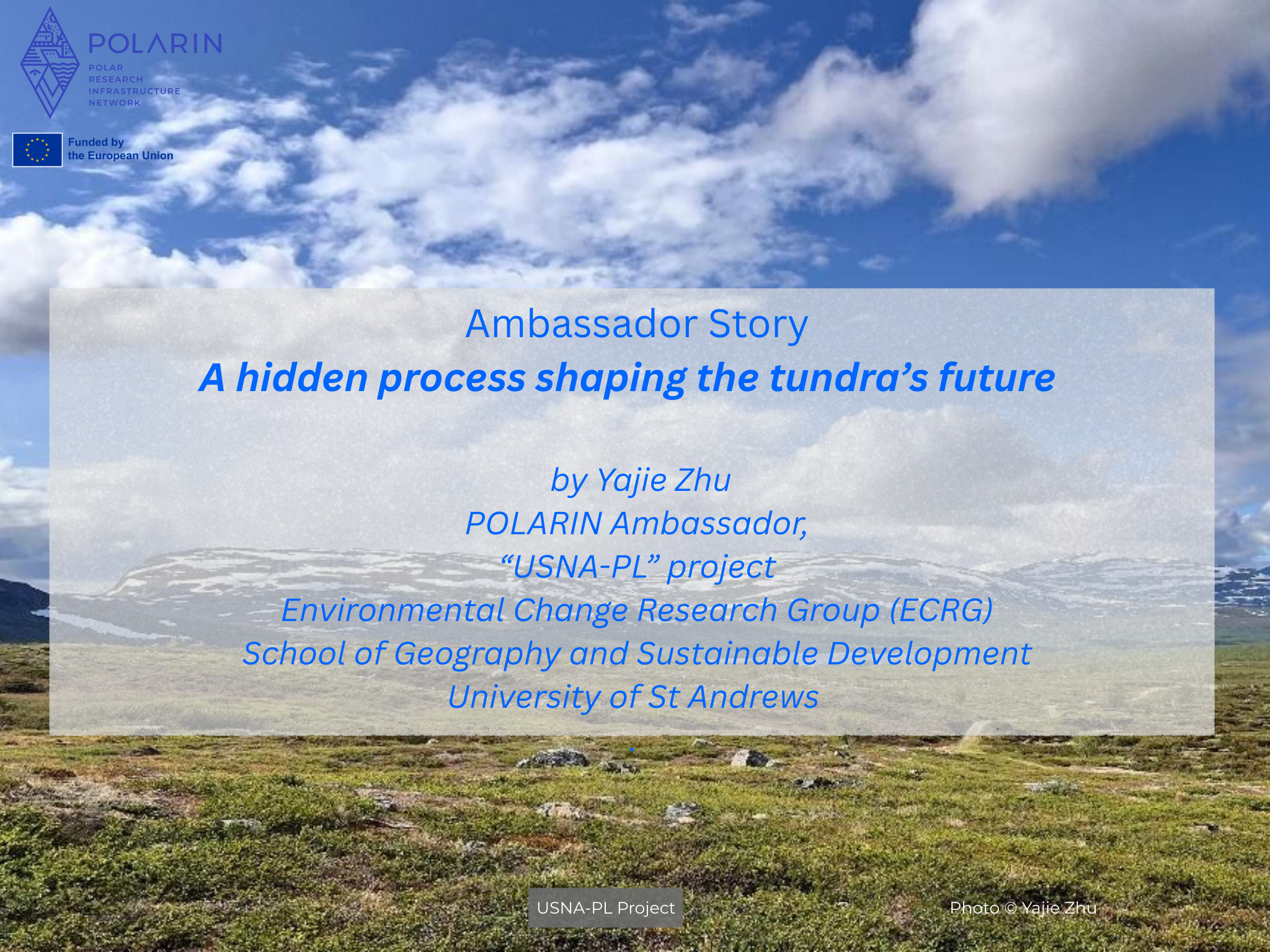
A hidden process shaping the tundra’s future
Tiny shifts beneath our feet are quietly reshaping the Arctic tundra. In a new POLARIN Ambassador blog, Yajie Zhu from the University of St Andrews takes readers to northern Finland to explore how subtle variations in soil nutrients and microtopography influence vegetation across one of the world’s fastest-changing ecosystems.
During June 2025, the USNA-PL research team travelled to the Kilpisjärvi Biological Station, at the meeting point of Finland, Sweden, and Norway, to carry out fieldwork supported by POLARIN’s first call on Transnational Access to Research Infrastructures. Working along the slopes of Mount Saana, the team investigated how small differences in elevation, moisture, and soil chemistry shape the mosaic of mosses, lichens, and plants that define the tundra landscape.
From installing in situ nutrient sensors and soil probes to flying drones that captured fine-scale patterns invisible to satellites, the field campaign combined careful ground observations with high-resolution spatial data. Transects and quadrats laid out across the hillside allowed researchers to follow gradual changes from dry ridges to wetter hollows, revealing how closely vegetation responds to local soil conditions.
In the blog, Zhu reflects on the challenges and rewards of Arctic fieldwork, highlighting how field data, while imperfect, bring models and satellite observations to life by grounding them in real landscapes.
The data collected during the field trip form the foundation for the next phase of the USNA-PL project, which aims to enhance understanding on how Arctic soil nutrient availability is represented from plot to landscape scales.
Read the full story in A hidden process shaping the tundra’s future by Yajie Zhu, POLARIN Ambassador and researcher at the University of St Andrews.
USNA-PL was funded by POLARIN’s first call for Transnational Access to Research Infrastructures.