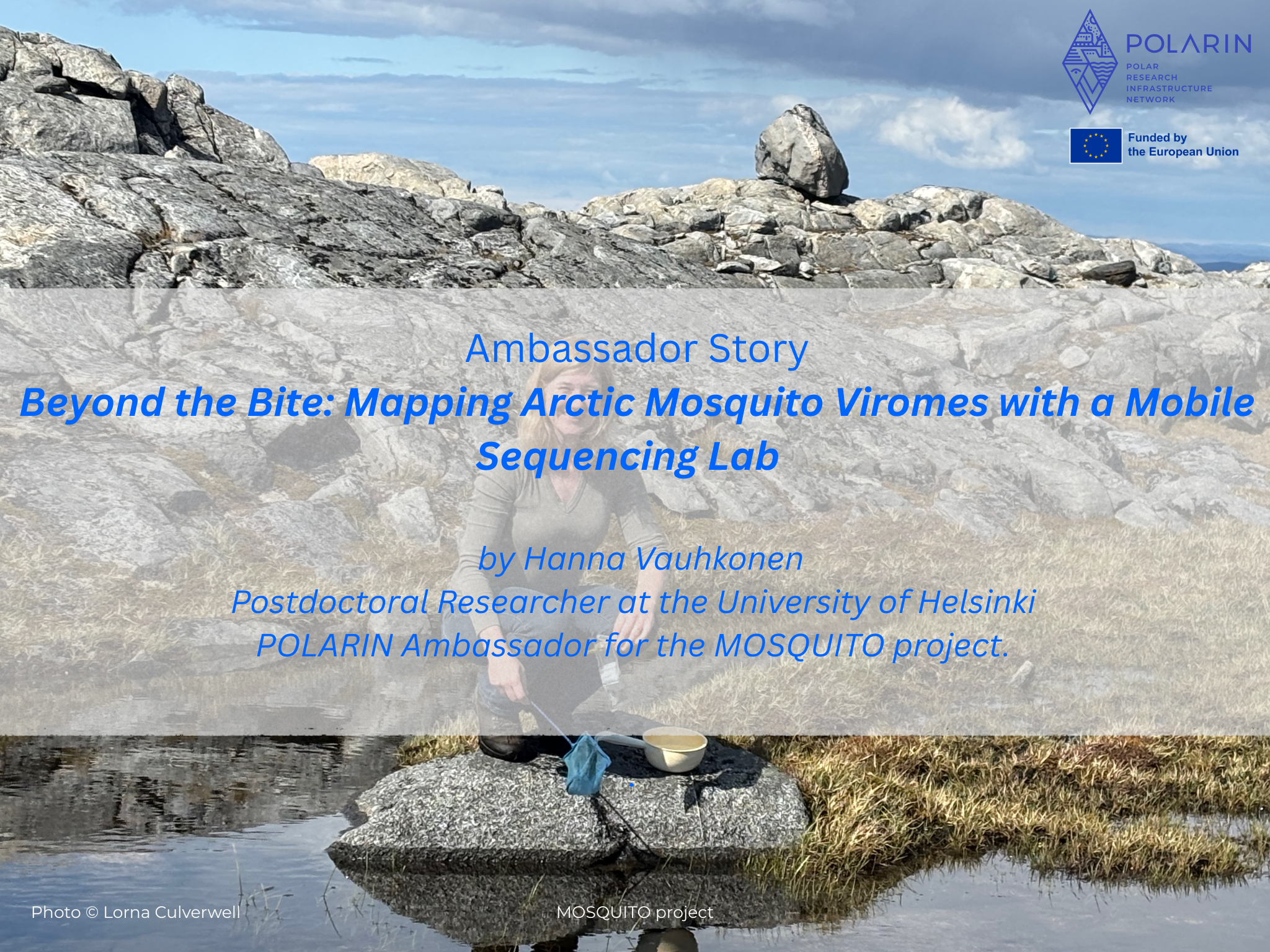
Beyond the Bite: Mapping Arctic Mosquito Viromes with a Mobile Sequencing Lab
What does it take to sequence mosquito viruses in remote Arctic environments?
In a new POLARIN Ambassador blog, Hanna Vauhkonen from the University of Helsinki shares the story of the MOSQUITO project’s field campaign in Greenland, where researchers combined field sampling with mobile sequencing technologies under typical Arctic research conditions. The project was funding by POLARIN’s first call on Transnational Access to polar research infrastructures.
Working from Nuuk and the Kobbefjord Research Station, the team carried out mosquito sampling and off-grid sequencing. Working from a mobile laboratory packed into cabin-size luggage, the researchers collected both larval and adult mosquitoes, adapting their sampling strategy to a delayed mosquito season and unpredictable weather. With solar panels, a backup generator, and offline sequencing software, the team successfully ran multiple Nanopore MinION sequencing experiments in the field even after flight cancellations, power outages, and long days of careful sample processing.
Despite logistical challenges, the results were striking. The team detected more than 50 virus taxa, including highly divergent and potentially endemic species, revealing a previously hidden layer of Arctic biodiversity. Differences between mosquito species highlighted how even simple Arctic ecosystems can host complex, host-specific viral communities.
In her blog, Hanna Vauhkonen reflects on the realities of Arctic fieldwork, from troubleshooting equipment during sequencing runs to enjoying moments of quiet in the fjord landscape after long hours in the lab. The experience underscores the importance of field-based observations and local reference databases for understanding how polar ecosystems, and their microbial networks, may respond to a warming climate.