POLAR-MOSS: Using Arctic Mosses to Trace Atmospheric Pollution in Svalbard
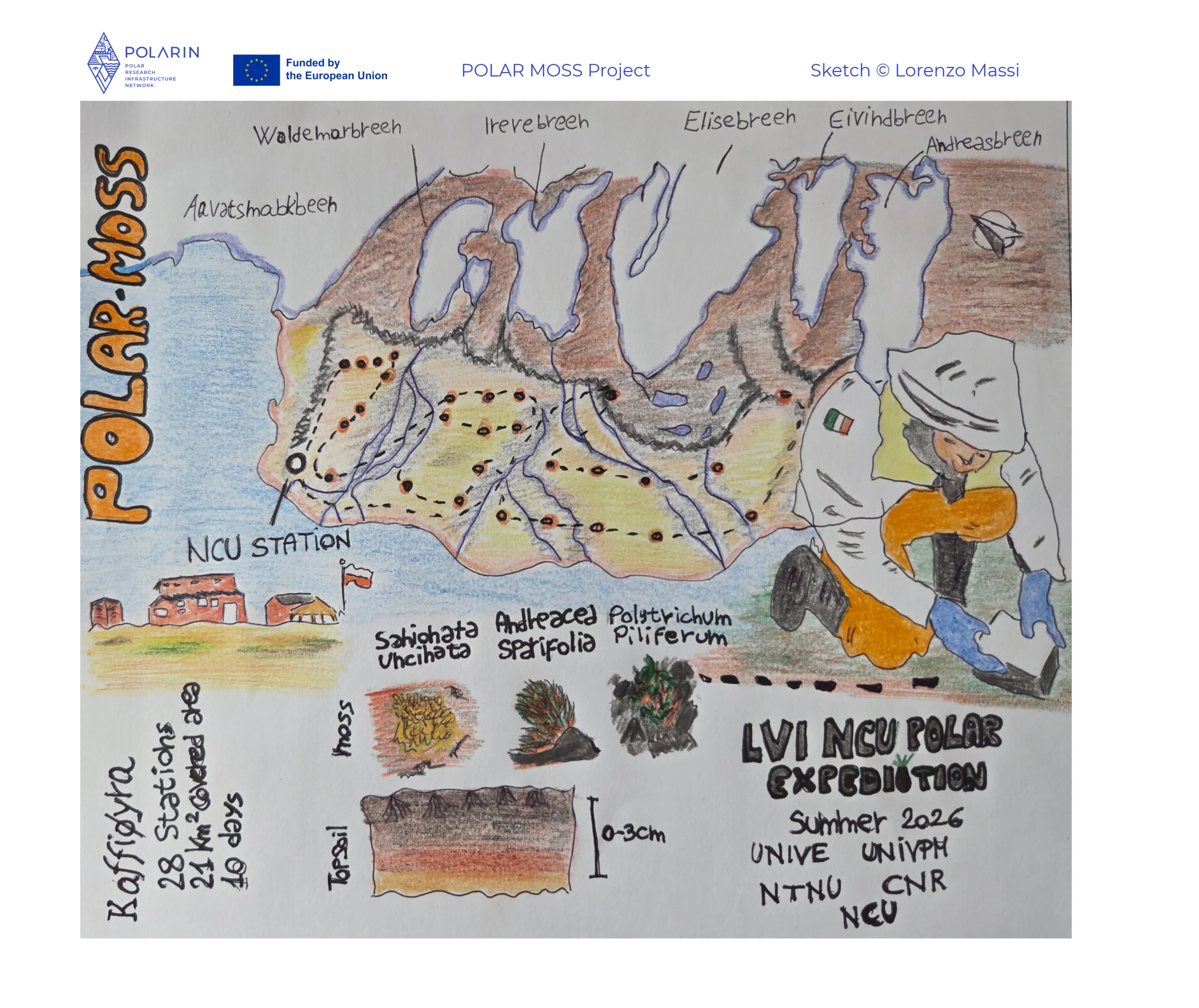
A visual story from the field by Lorenzo Massi, PhD student at Università Ca’ Foscari Venezia and POLARIN Ambassador, sharing the team’s experience of conducting fieldwork in the Kaffiøyra region of Svalbard during a POLARIN-supported expedition in August 2026.
The high Arctic may be considered by many a remote region, but it is not beyond the reach of atmospheric pollution. Through the POLAR-MOSS project, an international research team investigated how mosses can serve as natural indicators of pollutants transported over long distances and deposited in Arctic ecosystems.
Based at the Nicolaus Copernicus Polar Station in western Spitsbergen, the researchers explored the Kaffiøyra landscape, collecting moss and soil samples across 28 sampling stations covering approximately 21 km². Over five days of fieldwork, the team travelled around 60 kilometres through glacial plains, moraines and meltwater pathways, gathering 56 samples for subsequent laboratory analyses of trace metals, metalloids and polycyclic aromatic hydrocarbons (PAHs).
The story from Lorenzo Massi, PhD student at Università Ca’ Foscari Venezia adn POLARIN Ambassador, highlights the challenges of conducting research in the Arctic, from unpredictable weather and difficult terrain to adapting sampling strategies when the targeted moss species could not be found. It also offers a glimpse into daily life at the polar station, the spectacular landscapes of Svalbard and encounters with Arctic wildlife.
By combining field observations with future chemical analyses, POLAR-MOSS aims to improve our understanding of atmospheric pollutant deposition in remote polar environments and demonstrate the value of mosses as environmental biomonitors.
POLAR-MOSS was one of the projects supported through POLARIN’s secold Transnational Access call to polar research infrastructures.