POLAR-MOSS: Using Arctic Mosses to Trace Atmospheric Pollution in Svalbard
How can Arctic mosses help scientists understand pollution travelling thousands of kilometres? In August 2026, the POLARIN-supported POLAR-MOSS project brought an international research team to the Kaffiøyra region of Svalbard to investigate atmospheric pollution in one of the world’s most remote environments.
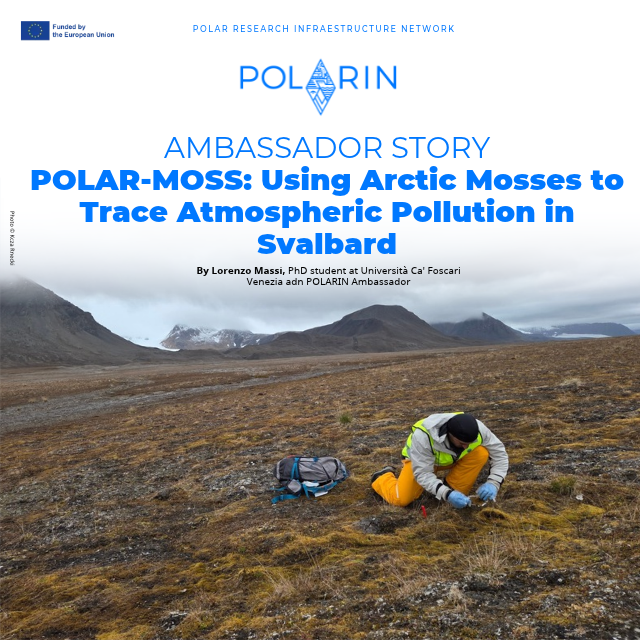
Based at the Nicolaus Copernicus Polar Station in western Spitsbergen, the researchers collected moss and soil samples to investigate the distribution of trace metals, metalloids and polycyclic aromatic hydrocarbons (PAHs). Mosses are particularly valuable as natural biomonitors because they absorb and accumulate substances directly from the atmosphere, providing insights into environmental contamination.
During the expedition, the team established 28 sampling stations across approximately 21 km², collecting 56 samples over five days of fieldwork. Despite challenging terrain, changing weather conditions and the absence of the initially targeted moss species, the researchers successfully completed their sampling campaign.
The collected samples will now undergo laboratory analyses to explore spatial patterns of atmospheric deposition and potential pollution sources.
POLAR-MOSS highlights the importance of international collaboration and access to polar research infrastructure in advancing our understanding of environmental processes in the Arctic.
Explore the visual field story by Lorenzo Massi, PhD student at Università Ca’ Foscari Venezia and POLARIN Ambassador, here.
Discover more photos from the expedition in the POLARIN Ambassadors’ Gallery here.