
RV Mirai II, JP
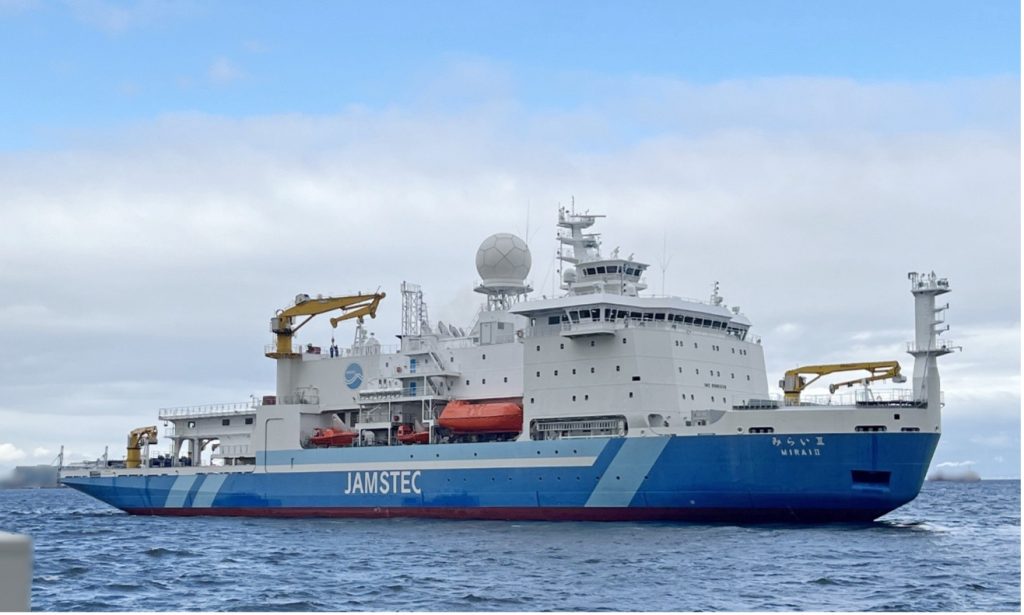
RV Mirai II, JP
RV Mirai II is an arctic research vessel with icebreaking capabilities and world-class scientific facilities. With a length of about 128 meters and an ice class of PC4, it can continuously break 1.2 meters of flat, first-year ice at 3.0 knots. This vessel is owned by the Japan Agency for Marine-Earth Science and Technology (JAMSTEC).
Contact
polarin_mirai2[at]jamstec.go.jp
Location
Home Port: Mutsu, Aomori, Japan
* Departure and boarding ports differ for each expedition.
Website
https://www.jamstec.go.jp/parv/e/
Facilities
RV Mirai II is a vessel with a length of about 128 m, a width of 23m, an ice class of PC4, and capable of continuously breaking 1.2 m of flat, one-year ice at a speed of 3.0 knots. This vessel can host 63 scientists and engineers and features 18 research laboratories, including three wet labs, as well as a meteorological radar system. It can accommodate AUV and ROV, and it is equipped to operate radiosondes. Additionally, up to three laboratory containers can be accommodated on the aft observation deck, and additional slots are provided on the helicopter deck and fore exposed deck. The vessel includes a moon pool, allowing for CTD observations to be conducted either through the moon pool or from the starboard side. Furthermore, a cold room located on the second deck can maintain temperatures as low as -25℃. Equipped with a wide range of observation facilities and equipment, the vessel can conduct high-precision, multi-parameter observations for atmospheric, oceanic, meteorological, and biological research.
<Main Observation Facilities and Capabilities (including portable systems)>
CTD/water sampling, sediment coring/sampling equipment, net sampling, seafloor exploration systems, fish finders, meteorological observation systems, doppler radar, radiosonde, exhaust gas sensors, ROV (Remote Operated Vehicle), small AUV (Autonomous Underwater Vehicle), aircraft, man-riding basket, ice load monitoring, etc.
Additional observation containers (10ft and 20 ft) can be accommodated.
*Equipped instruments and facilities are subject to change in the future.
Services offered
Access will be provided with a work plan of up to 5 operational days (or working time equivalent to the operational days) for a user group of up to 3 users on each expedition.
Unit of access
User/day
What is included in the Access
The access includes full access to onboard facilities and instruments and feasibility studies by JAMSTEC coordinators. Technical crew will support the science team for operating the scientific equipment.
Due to budget limitations for this access, POLARIN will not cover the costs of transporting heavy equipment (e.g. ROVs or other large scientific instruments) by cargo. If your project requires the transport of such equipment, you must secure alternative funding for these costs. Projects requiring cargo transport without dedicated funding cannot be supported through this access. Please note that even if you secure alternative funding (including paying at your own expense), you must consult the infrastructure operator (JAMSTEC) in advance to confirm the feasibility of the transport and load the equipment before submitting your TAP application.
Availability of Access
See the table on the dedicated Transnational Access call page.
Cruises
・February-March 2028 Sea of Okhotsk
・June-August 2028 the Pacific side of the Arctic Ocean (e.g. the Chukchi and Beaufort Seas)
* The schedule is subject to change depending on future circumstances.
Time frame for access preparations
Time frame for pre-consultation on the proposal feasibility with the RI operator (JAMSTEC): before proposal submission
The frame for logistic arrangements to access the RI (e.g., equipment transport and permit applications): 8 months before access
The frame to receive the documentation from RI users (after access is granted): Less than one month
* Users will join already scheduled expeditions which take place in the areas they want to visit.
Insurance
JAMSTEC does not insure the onboard researchers and/or the materials and equipment they bring aboard. In addition, JAMSTEC, the operating company, and the crew of the ship will not be liable for any damage or loss of materials and equipment brought in by the researcher after the ship is loaded and during land transportation before and after the cruise. To prepare for unforeseen accidents, disasters, or illnesses, it is the responsibility of researchers to obtain necessary insurance (travel accident insurance, freight insurance, student insurance, etc.).
Medical guidelines
Participants must satisfy the medical fitness criteria established by JAMSTEC.
Onboard Expenses
Accepted applicants will be responsible for their own onboard expenses (meals, linen cleaning, phone calls, etc.). A bill will be issued before you disembark, and we kindly ask that you settle the payment.
- Only the costs for meals and linen cleaning are eligible for reimbursement by POLARIN. Phone calls and any other personal expenses are not eligible.
- Applicants must include the estimated costs for meals and linen cleaning in the budget calculated in TAP to ensure these expenses are covered by the project.
- Reimbursement will be made to the user based on the detailed invoice issued by the vessel operator.
* The estimated costs are approximately 2,000 JPY (about 11 EUR) per day for meals, and approximately 1,000 JPY (about 6 EUR) once every two weeks for linen cleaning.