January 16, 2026

News

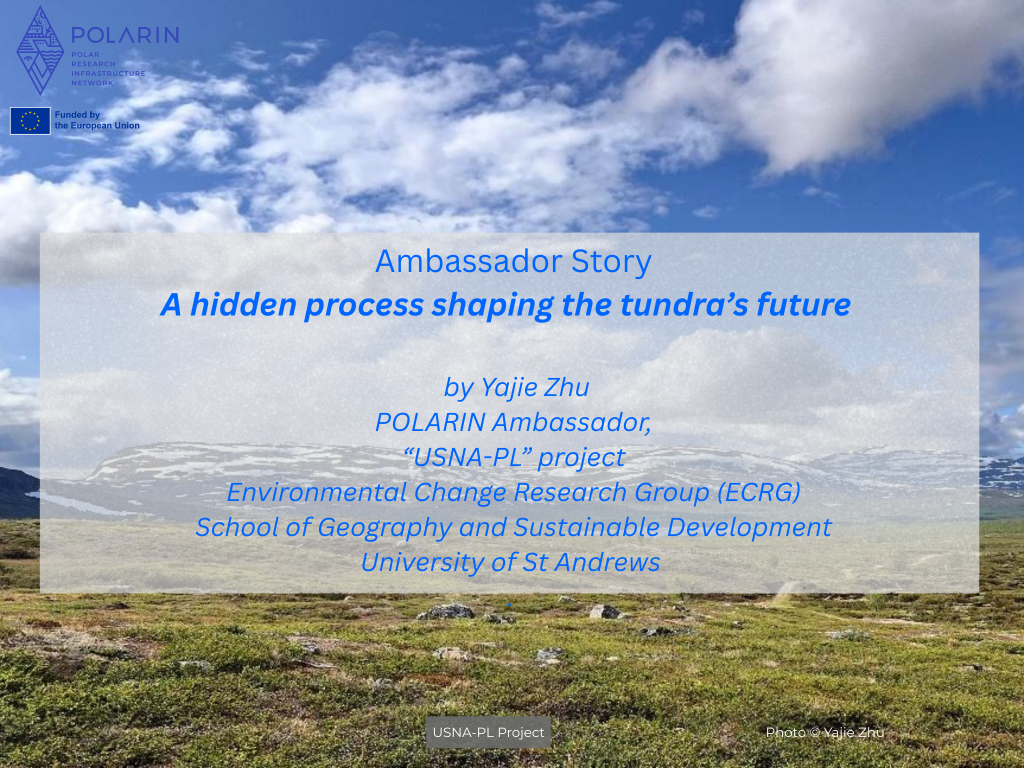
A hidden process shaping the tundra’s future​​​- New POLARIN Ambassador Blog Post!

A hidden process shaping the tundra’s future​ Tiny shifts beneath our feet are quietly reshaping the Arctic tundra. In a new POLARIN Ambassador blog, Yajie Zhu from the University of St Andrews takes readers to northern Finland to explore how subtle variations in soil nutrients and microtopography influence vegetation across one of the world’s fastest-changing ecosystems.   During June 2025, the USNA-PL research team travelled to the Kilpisjärvi Biological Station, at the meeting point of Finland, Sweden, and Norway, to carry out fieldwork supported by POLARIN’s first call on Transnational Access to Research Infrastructures. Working along the slopes of Mount Saana, the team investigated how small differences in elevation, moisture, and soil chemistry shape the mosaic of mosses, lichens, and plants that define the tundra landscape.   From installing in situ nutrient sensors and soil probes to flying drones that captured fine-scale patterns invisible to satellites, the field campaign combined careful ground observations with high-resolution spatial data. Transects and quadrats laid out across the hillside allowed researchers to follow gradual changes from dry ridges to wetter hollows, revealing how closely vegetation responds to local soil conditions.   In the blog, Zhu reflects on the challenges and rewards of Arctic fieldwork, highlighting how field data, while imperfect, bring models and satellite observations to life by grounding them in real landscapes. The data collected during the field trip form the foundation for the next phase of the USNA-PL project, which aims to enhance understanding on how Arctic soil nutrient availability is represented from plot to landscape scales.   Read the full story in A hidden process shaping the tundra’s future by Yajie Zhu, POLARIN Ambassador and researcher at the University of St Andrews.   USNA-PL was funded by POLARIN’s first call for Transnational Access to Research Infrastructures.
News

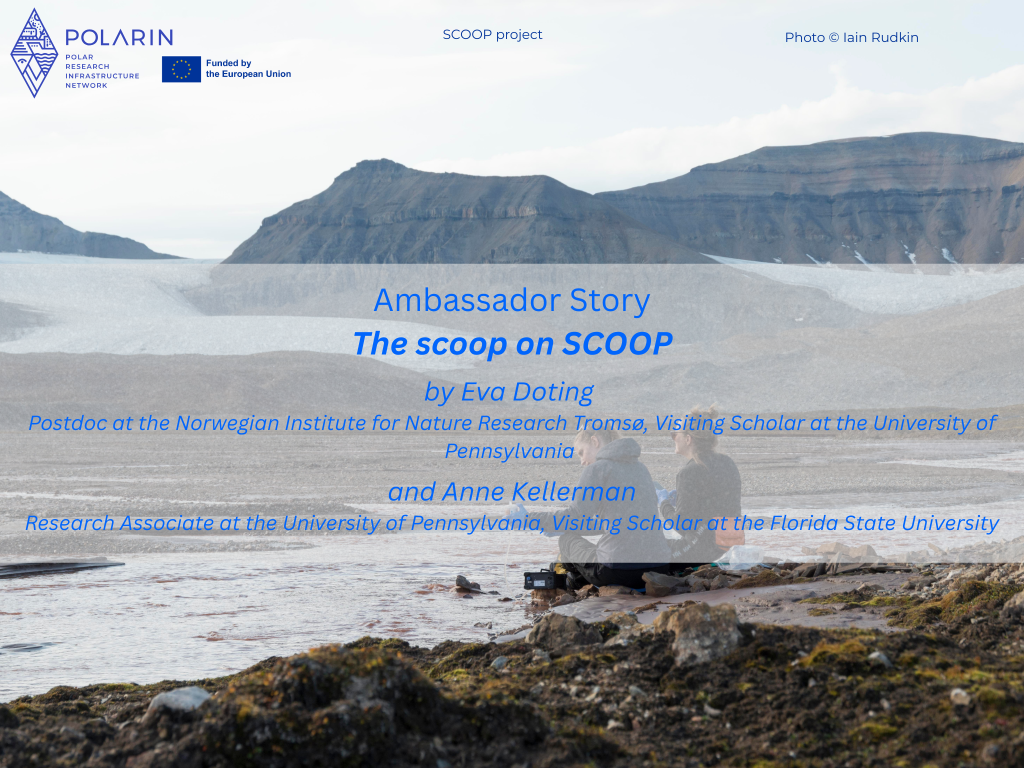
The scoop on SCOOP –  New POLARIN Ambassador Blog Post!

The scoop on SCOOP The researchers Eva Doting (Postdoc at the Norwegian Institute for Nature Research Tromsø, Visiting Scholar at the University of Pennsylvania), and Anne Kellerman (Research Associate at the University of Pennsylvania, Visiting Scholar at the Florida State University) recently completed a High Arctic field campaign in Ny-Ålesund, Svalbard and the NERC Arctic Research Station, tracking how meltwater from retreating glaciers carries carbon and nutrients from ice to fjord.   As part of the POLARIN funded project SCOOP (Sources and Cycling Of Organic matter along glacial-proglacial-fjord flow Paths), they sampled supraglacial streams, proglacial rivers, and fjord waters around Austre Brøggerbreen and Midtre Lovénbreen, capturing how newly exposed soils and melting ice are reshaping the flow of life-supporting elements into the Arctic Ocean. Back in the lab, the team began analyzing how microbes break down this glacier-derived organic matter and nitrogen, helping reveal how Arctic fjord ecosystems may change as glaciers continue to retreat.   Step into the Arctic with Eva and Anne to discover how ice, soil, and sea are linked by climate change.   SCOOP was funded by POLARIN’s first call for Transnational Access to Research Infrastructures.
Ambassador

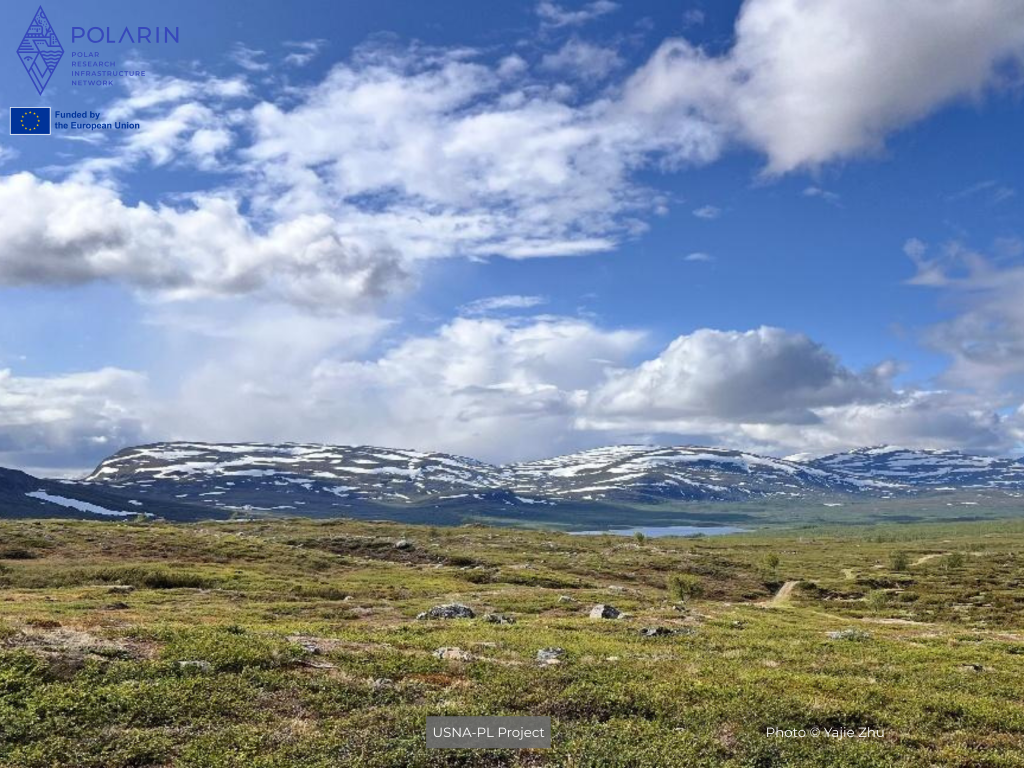
A hidden process shaping the tundra’s future​

A hidden process shaping the tundra’s future by Yajie Zhu, PhD researcher at the University of St Andrews and POLARIN Ambassador for the USNA-PL project.   In summer 2025, researchers from the University of St Andrews travelled to Kilpisjärvi in northern Finland as part of the USNA-PL project, supported by POLARIN’s Transnational Access programme. Working from the Kilpisjärvi Biological Station and across the slopes of Mount Saana, the team explored how fine-scale differences in soil nutrients and microtopography shape tundra vegetation.   Through detailed field surveys, in situ sensors, and drone mapping, the researchers captured patterns that are often invisible to satellites but crucial for understanding how tundra ecosystems respond to climate change. The work highlights the importance of ground-based observations in highly fragmented Arctic landscapes and provides essential data for improving land-surface models. Read more in A hidden process shaping the tundra’s future, the Ambassador blog by Yajie Zhu, PhD researcher at the University of St Andrews and POLARIN Ambassador for the USNA-PL project.   USNA-PL  was one of the projects successfully selected through POLARIN’s first call.    Download

Scroll to Top