
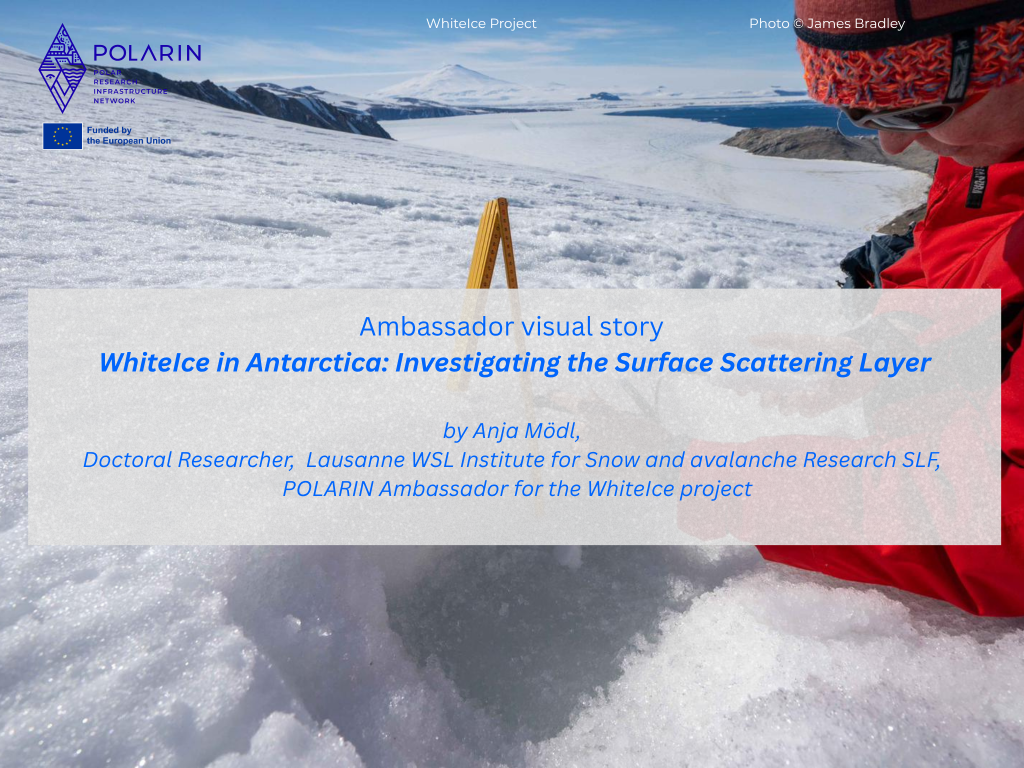
WhiteIce in Antarctica: Investigating the Surface Scattering Layer- New Ambassador visual story from the field!
WhiteIce in Antarctica: Investigating the Surface Scattering Layer How the Antarctic ice surface exchanges energy with the atmosphere remains one of the key uncertainties in climate modelling. During the 2024–2025 field season, Anja Mödl, together with her team, travelled to Mario Zucchelli Station in East Antarctica to investigate a little-studied feature known as the surface scattering layer (SSL). The expedition was supported through POLARIN’s first Transnational Access call and combined automated monitoring with intensive on-site measurements on the Nansen Ice Shelf, around 37 kilometres from the research station. The focus was on how summer melting reshapes the ice surface and alters the local energy balance. The SSL develops when bare glacier ice begins to melt, allowing meltwater to seep into the surface and later evaporate. What remains is a layer of granular ice crystals that can resemble snow, but is actually a transformed ice surface. Capturing how this layer forms and evolves is important for improving the way climate models represent polar ice processes. Fieldwork in Antarctica comes with logistical and environmental challenges, and this campaign was no exception. Alongside technical work, the team operated in the striking environment of Terra Nova Bay, where encounters with Adélie penguins, seals, and skuas were part of the daily backdrop. More details are shared in the WhiteIce Ambassador visual story by Anja Mödl. WhiteIce was one of the projects successfully selected through POLARIN’s first call for Transnational Access to Polar Research Infrastructures.